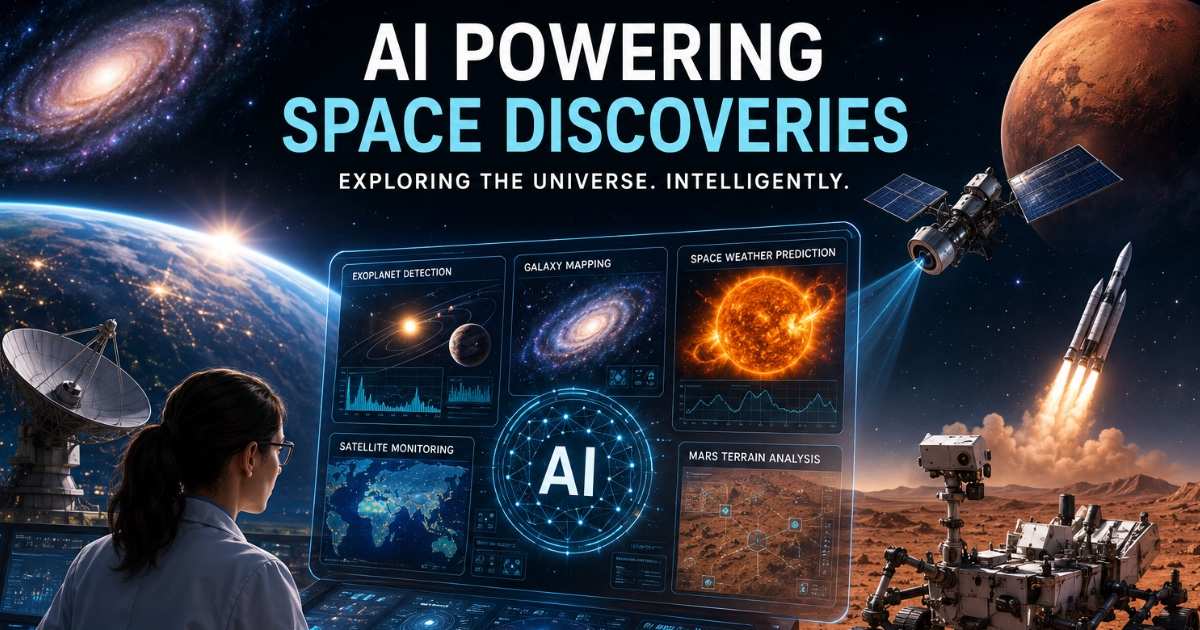
AI Helping Scientists Discover New Space Data: How Artificial Intelligence Is Transforming Modern Space Exploration
Artificial intelligence is helping scientists process massive amounts of space information faster than ever before, transforming how researchers discover planets, study galaxies, predict space weather, and prepare for future missions beyond Earth.
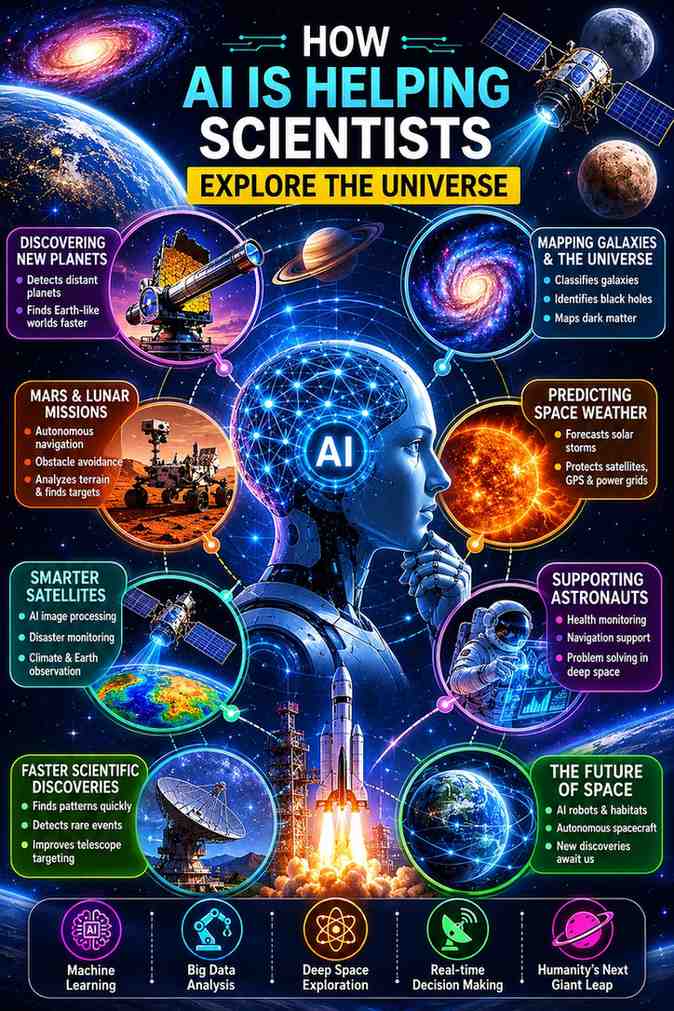
Artificial intelligence is rapidly becoming one of the most important technologies shaping the future of space exploration. Scientists and engineers across the world are increasingly turning to AI systems to solve one of modern astronomy’s biggest challenges: managing and understanding enormous amounts of data generated by space missions. From deep-space telescopes and satellites to Mars rovers and lunar exploration systems, modern scientific instruments collect huge amounts of information every day. Researchers say artificial intelligence is now helping them process and analyze this information at a speed that was previously impossible.
Space research has entered a new era where the amount of information collected is expanding at an extraordinary pace. Advanced telescopes can observe distant galaxies, detect cosmic radiation, monitor star systems, and capture millions of images during short observation periods. Earth-monitoring satellites continuously collect environmental and atmospheric data, while robotic missions send back measurements from distant locations across the solar system.
Scientists explain that manually reviewing all this information can take years. Human researchers can analyze only limited amounts of data within a given time frame. Artificial intelligence changes this process by identifying patterns, highlighting unusual observations, and filtering important discoveries from enormous datasets. Researchers believe this capability is becoming increasingly valuable as future missions become more advanced and data generation continues growing.
One of the biggest areas where AI is making an impact is the search for planets beyond Earth. Exoplanets, which are planets located outside our solar system, are often discovered through small changes in the brightness of stars. When a planet passes in front of a star, it creates a tiny dip in brightness that telescopes can detect.
Space telescopes collect huge volumes of brightness measurements from distant stars. Artificial intelligence systems can rapidly analyze this information and identify possible planetary signals that may otherwise remain hidden. Machine learning systems are helping astronomers detect faint patterns and reduce errors during the search process.
Scientists say AI is assisting researchers in identifying Earth-like planets, classifying star systems, predicting orbital movements, and filtering false signals. Some experts believe future AI systems may even help identify planets with conditions that could support life.
Artificial intelligence is also transforming how scientists study galaxies and the structure of the universe. Modern astronomical surveys capture images of billions of galaxies across vast regions of space. Sorting and classifying these galaxies manually would require extraordinary amounts of time and effort.
Researchers now use AI tools to classify galaxy shapes, detect black holes, identify gravitational lensing effects, and analyze cosmic radiation. AI systems can identify subtle visual differences in astronomical images much faster than traditional methods.
Scientists believe this technology may help improve understanding of major questions related to the universe, including how galaxies formed, how cosmic expansion evolved over time, and how dark matter influences large-scale structures.
AI is also becoming increasingly important for robotic exploration missions. Spacecraft operating on the Moon or Mars often experience communication delays with Earth. Because of these delays, real-time control becomes difficult during exploration activities.
Artificial intelligence helps robotic systems make independent decisions. AI-powered navigation systems can help rovers avoid obstacles, identify safer routes, manage energy consumption, and select scientifically important targets.
Researchers say autonomous systems become especially important during deep-space exploration because spacecraft may need to react quickly to changing conditions. Future missions involving long-distance exploration could rely heavily on AI-driven systems capable of independent problem-solving.
Scientists also believe intelligent robots may eventually help construct lunar habitats, support astronauts, and perform maintenance tasks in future space settlements.
Space weather prediction represents another important area where AI is helping scientists. Solar storms, radiation bursts, and magnetic disturbances originating from the Sun can create major disruptions on Earth and in space.
These events can affect satellites, GPS systems, communication networks, electricity infrastructure, and astronaut safety. Monitoring solar activity involves analyzing complex data collected from observation systems.
Machine learning tools are now helping researchers predict solar flare behavior, monitor radiation changes, identify magnetic disturbances, and improve forecasting accuracy. Scientists say faster prediction systems may help governments and industries prepare for space weather events more effectively.
As the world becomes increasingly dependent on satellite technology, accurate forecasting systems are becoming more important than ever.
Artificial intelligence is also changing the capabilities of satellite systems themselves. Modern satellites are becoming smarter through onboard AI processing systems.
Instead of transmitting every piece of raw information back to Earth, some satellites can process data directly while in orbit. This approach improves efficiency and reduces communication delays.
AI-assisted satellites are increasingly being used for weather monitoring, environmental research, agricultural mapping, maritime observation, urban planning, and disaster response.
Scientists use satellite systems to monitor floods, droughts, wildfires, glacier movement, pollution levels, and ocean activity. Environmental researchers believe AI-powered observations could play a major role in future climate research and global disaster management efforts.
Major space agencies around the world are increasing investment in AI-related technologies. Organizations including NASA, ISRO, ESA, and other global research organizations are exploring AI applications across multiple areas.
Current areas receiving attention include autonomous spacecraft navigation, intelligent robotics, mission planning systems, astronaut support tools, and advanced communication technologies.
Industry experts say artificial intelligence may reduce mission costs while improving operational efficiency. AI systems may also help optimize fuel usage, monitor spacecraft health, and improve launch planning.
Future missions involving astronauts traveling to the Moon or Mars may depend heavily on intelligent support systems. Deep-space travel creates major challenges because communication with Earth becomes slower over long distances.
Scientists believe AI systems may help astronauts with medical monitoring, technical troubleshooting, emergency management, scientific analysis, and daily mission operations.
Some researchers suggest future AI assistants could function almost like mission partners during long-duration space travel.
Private aerospace companies are also investing heavily in artificial intelligence. Commercial firms are increasingly using AI for reusable launch systems, predictive maintenance, satellite operations, communication systems, and orbital traffic management.
Experts believe partnerships between private companies and research institutions may accelerate innovation across the global space sector.
Despite rapid progress, researchers emphasize that challenges still remain. Concerns include algorithm reliability, cybersecurity risks, system failures, and dependence on automated decision-making.
Scientists stress that human oversight remains essential. Space missions operate in high-risk environments where mistakes can create major consequences. Experts say AI systems must undergo extensive testing before they are trusted with critical mission responsibilities.
Artificial intelligence is not replacing scientists. Instead, researchers describe AI as a powerful tool that enhances human capabilities. Human expertise remains necessary for understanding scientific meaning, verifying discoveries, and guiding future research directions.
As future telescopes become more powerful and space missions become increasingly ambitious, scientists believe AI will continue becoming an invisible but essential part of exploration.
Researchers say the next era of discovery may depend not only on rockets and spacecraft but also on intelligent systems capable of understanding the universe at unprecedented speed and scale. The growing partnership between artificial intelligence and space science may ultimately help humanity answer some of its biggest unanswered questions about the cosmos and our place within it.
Key Insights
- Artificial intelligence is becoming a major driver of modern space exploration and scientific research.
- Space missions generate massive amounts of data that are difficult for humans to analyze manually.
- AI helps scientists process huge datasets faster and identify important patterns and discoveries.
- Machine learning is improving the discovery of exoplanets and Earth-like worlds beyond our solar system.
- AI systems are helping astronomers classify galaxies, detect black holes, and study cosmic events.
- Mars rovers and lunar robots increasingly rely on AI for autonomous navigation and decision-making.
- AI-powered systems can help predict dangerous space weather events such as solar storms and radiation bursts.
- Smart satellites now use AI for climate observation, disaster monitoring, and Earth analysis.
- Major global space agencies are investing heavily in AI research and intelligent space technologies.
- AI may support astronauts in future Moon and Mars missions through medical, technical, and operational assistance.
- Private aerospace companies are using AI for reusable rockets, satellite networks, and mission optimization.
- Human oversight remains essential despite advances in automation and artificial intelligence.
- Future space discoveries may increasingly depend on AI systems capable of handling unprecedented amounts of information.
- The combination of AI, robotics, and space technology could redefine humanity’s understanding of the universe.
Last Updated on: Monday, May 25, 2026 7:42 pm by Pushkarini Annabathula | Published by: Pushkarini Annabathula on Monday, May 25, 2026 7:38 pm | News Categories: Latest
About The Author